
Calorie Calculator Online Free
Calorie Calculator
Enter your details to calculate calories.
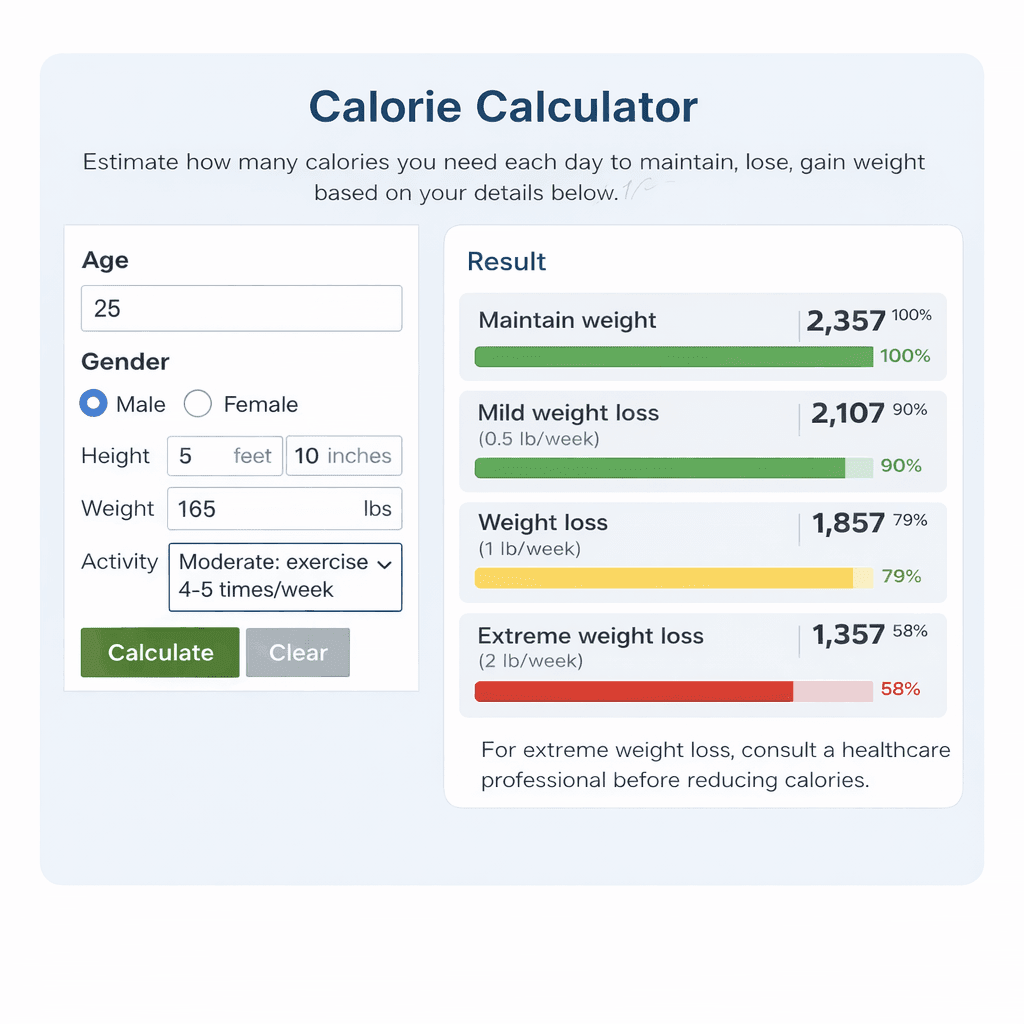
Your Daily Calorie Needs
EstimatesMaintain weight
Mild weight loss
0.5 lb/week
Weight loss
1 lb/week
Extreme weight loss
2 lb/week
Zigzag Calorie Cycling
Zigzag calorie cycling helps prevent metabolic adaptation. By varying your intake, you keep your body guessing and may break through plateaus.
Schedule 1 (Mild Fluctuation)
| Day | Calories |
|---|
Schedule 2 (High Fluctuation)
| Day | Calories |
|---|
Food Energy Converter
Starting a health journey often feels overwhelming, but it doesn’t have to be. One of the most effective ways to take control of your body is by understanding your energy needs. This is where a calorie calculator becomes your best friend. Whether you want to shed a few pounds, build lean muscle, or simply maintain your current energy levels, knowing how many calories your body requires is the essential first step.
Our Calorie Calculator is built using the advanced Google Gemini Pro Web Builder technology, ensuring high precision and reliable data processing. This state-of-the-art AI integration allows for a more personalized and accurate estimation of your daily energy needs compared to traditional tools. An online free calorie calculator takes the guesswork out of dieting, providing you with a personalized roadmap based on your age, gender, weight, height, and activity level. In this comprehensive guide, we will explore how you can use this tool to transform your relationship with food and achieve your fitness goals with confidence.
Many people view calories as the enemy, but in reality, they are simply the fuel that keeps your heart beating, your brain thinking, and your muscles moving. Using a calorie calculator helps you find that “sweet spot” where you are giving your body exactly what it needs to thrive. Instead of following generic diets that don’t account for your unique lifestyle, a digital calculator offers a data-driven approach. It’s not about restriction; it’s about empowerment. Let’s dive into the details of how energy balance works and why a “Calorie Calculator Online Free” is the most practical tool you can have in your wellness arsenal.
The Science of Energy Balance: How a Calorie Calculator Works Its Magic
To get the most out of your calorie calculator, it is helpful to understand the science behind the numbers. At its core, weight management is governed by the law of thermodynamics: energy in versus energy out. Your body burns energy in several primary ways, and a high-quality calculator accounts for all of them to give you an accurate daily total. This state of equilibrium is known as energy homeostasis.
1. Basal Metabolic Rate (BMR)
Your BMR is the number of calories your body burns just to stay alive while at rest. Even if you stayed in bed all day, your body would still need energy for breathing, circulating blood, and cell production. BMR usually accounts for about 60-75% of your total daily energy expenditure. A precise calorie calculator uses the Mifflin-St Jeor equation to estimate this accurately based on your metabolic demands.
2. Thermic Effect of Food (TEF)
Did you know that you burn calories just by eating? Digesting, absorbing, and storing nutrients requires energy. Protein has the highest thermic effect, meaning your body burns more energy processing chicken or lentils than it does processing fats or simple sugars. This is a crucial factor that a smart calorie calculator helps you balance.
3. Physical Activity Level (PAL)
This is the most variable part of the equation. It includes everything from intense gym sessions to “Non-Exercise Activity Thermogenesis” (NEAT). A calorie calculator categorizes activity into levels such as:
Sedentary: Little or no exercise.
Light: Exercise 1-3 times per week.
Moderate: Exercise 4-5 times per week.
Active: Daily exercise or intense exercise 3-4 times per week.
Very Active: Intense exercise 6-7 times per week.
Extra Active: Very intense exercise daily or a highly physical job.
Zigzag Calorie Cycling: Overcoming the Weight Loss Plateau
One of the most advanced features of a modern calorie calculator is the ability to plan for “Zigzag Calorie Cycling.” As you keep a low-calorie diet, your body eventually adapts to the lower energy environment, which can lead to a frustrating progress plateau.
Zigzag calorie cycling, also known as a “zigzag diet,” is a method of varying your calorie consumption to keep your metabolism guessing and prevent this adaptation. By alternating between higher and lower calorie days, you can potentially overcome plateaus and stay on track toward your goals.
Sample Zigzag Diet Schedules
A calorie calculator often provides two types of schedules to help you maintain momentum:
Schedule 1 (Intermittent High Days): Keeping five days at a lower calorie level and two days (usually weekends) at a higher “maintenance” level. For example, if your maintenance is 2,239 calories, you might eat 1,889 calories on weekdays and 2,239 on Saturday and Sunday.
Schedule 2 (Gradual Variance): This involves a more fluid change throughout the week, where calorie intake increases and decreases daily, peaking mid-week.
Step-by-Step Guide: Getting Accurate Results from Your Calorie Calculator
While using a calorie calculator is simple, the quality of your results depends on the accuracy of your input. To ensure you are getting the best possible advice for your body, follow these friendly tips:
Input Precise Data: Most tools allow you to toggle between US Units (feet/inches/pounds) and Metric Units (centimeters/kilograms). Ensure you are using the correct scale to avoid calculation errors.
Identify Your Target Goal: * Maintain Weight: Consuming 100% of your TDEE.
Mild Weight Loss: A deficit aimed at losing 0.5 lb/week (approx. 89% of maintenance).
Weight Loss: Aiming for 1 lb/week (approx. 78% of maintenance).
Extreme Weight Loss: Aiming for 2 lb/week (approx. 55% of maintenance). Note: Consult a doctor if aiming for this level, as it often falls below the recommended minimum of 1,500 calories/day.
Activity vs. Results: An effective way to lose weight aside from reducing food intake is increasing activity. For instance, moving from “Moderate” to “Intense exercise 6-7 times per week” can increase weight loss by an additional 1.2 lbs per week.
Food Energy Converter: Understanding Calories vs. Kilojoules
When reading food labels or using a calorie calculator, you might encounter different units of energy. While “Calorie” (kcal) is common in the US and India, many international labels use “Kilojoules” (kJ).
A standard Food Energy Converter helps you switch between these units easily:
1 Calorie
$$Nutritional, kcal$$= 4.1868 Kilojoules
$$kJ$$1 Kilojoule
$$kJ$$= 0.239 Calories
$$kcal$$
Understanding this conversion is essential for international travelers or anyone using imported nutritional products. A comprehensive calorie calculator often includes a built-in converter to ensure you never miscalculate your daily energy intake, regardless of the unit used on the packaging.
Why Calories Matter: Building Authority Over Your Own Health
Using a calorie calculator consistently helps you build “Expertise” over your own body’s needs. Obesity and overweight status are major risk factors for chronic conditions like Type 2 diabetes and cardiovascular diseases. By staying within a healthy range, you are actively reducing your risk profile.
Furthermore, managing your calories helps regulate your mood. Sufficient intake prevents the “brain fog” associated with extreme dieting. When you track your intake against the output suggested by your calorie calculator, you are using a verified method backed by decades of metabolic research, building a foundation of trust in your own progress.
FAQs: Common Questions About Using a Calorie Calculator Online Free
Is a calorie calculator 100% accurate?
It provides a high-quality estimate (approx. 90-95% accuracy). Use it as a starting point and adjust based on your real-world progress over 2-4 weeks.
What is the minimum calorie intake recommended?
Most health experts suggest not dropping below 1,500 calories a day for men and 1,200 for women without medical supervision to ensure adequate micronutrient intake.
Can I track my progress on paper?
Yes! You can track your calories and progress on paper or using a mobile app. The key is to make adjustments as your weight changes, because your BMR will decrease as you get lighter.
Conclusion and Your Next Step
Understanding your energy needs is the most powerful thing you can do for your health. A calorie calculator removes the mystery from nutrition and replaces it with a clear, achievable plan. Whether you use Zigzag cycling to beat a plateau or a Food Energy Converter to read international labels, these tools empower you to take charge.
Are you ready to see what your body is capable of? Use our Calorie Calculator Online Free right now to find your daily target. Once you have your number, try tracking your food for just one week. You will be amazed at how much easier it is to reach your goals when you have the right data on your side!