
Profit Margin Calculator
Profit Margin Calculator
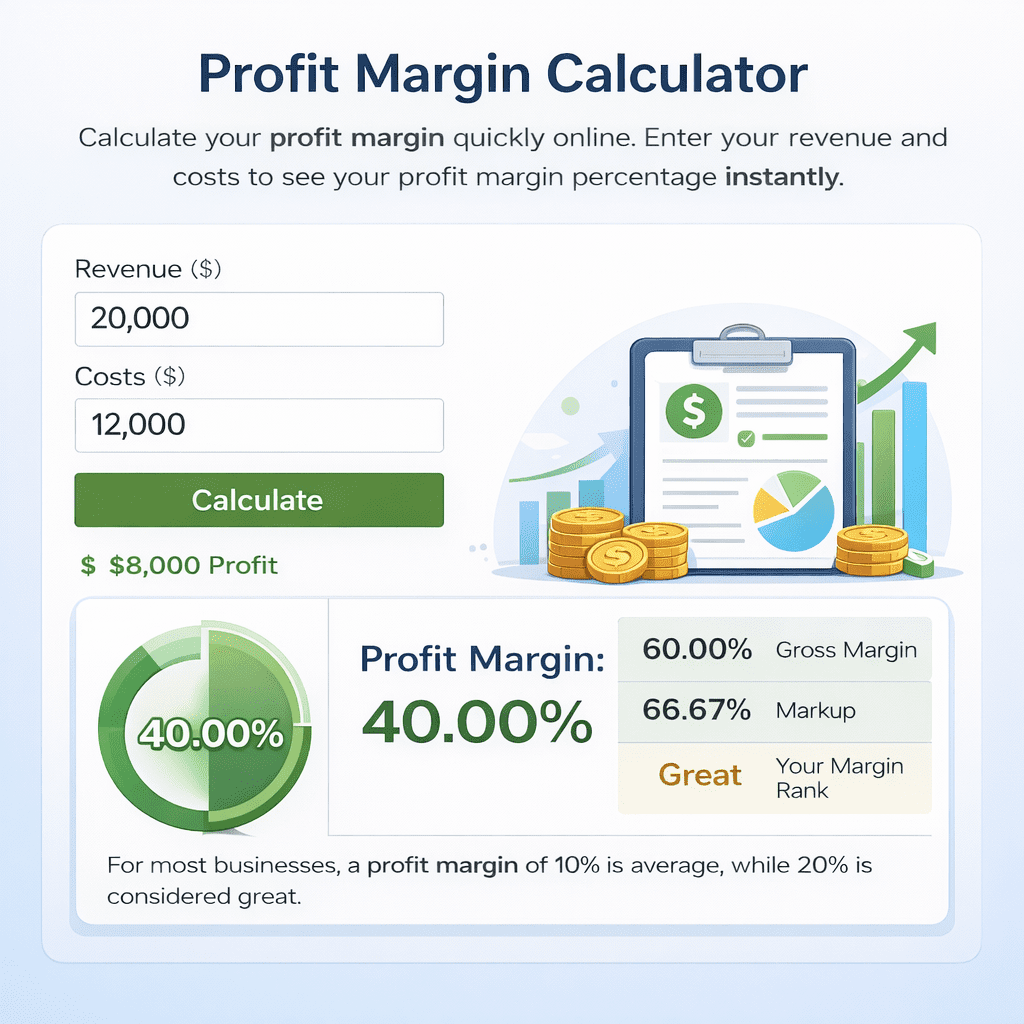
Enter any two fields below to calculate the rest.
Cost: The cost of the product/service.
Revenue: The income generated by selling the product.
Profit: The money left after deducting cost from revenue.
Margin: The percentage of profit vs. revenue.
Markup: The percentage of profit vs. cost.
Stock Trading Margin Calculator
Amount Required
$0.00
Business success isn’t just about how much you sell; it’s about how much you keep. Whether you are a small business owner in New York or an e-commerce giant scaling globally, understanding your numbers is the difference between thriving and barely surviving. Our Profit Margin Calculator is designed to give you instant, professional-grade financial clarity.
Stop guessing your markups and start calculating your success. This free online Margin Calculator simplifies complex financial formulas into a single click, allowing you to focus on what you do best: growing your brand. In this comprehensive guide, we will break down the essential metrics that every entrepreneur needs to master to ensure long-term profitability and sustainable growth.
Why Profitability is the Lifeblood of Your Business
Revenue is vanity, but profit is sanity. Many businesses fail because they confuse high sales volume with actual financial health. Using a Profit Margin Calculator helps you see the reality behind the curtains. It tracks the percentage of revenue that remains after all costs are paid.
A high-performing business doesn’t just happen by accident. It is built on data. By utilizing our online tool, you gain an immediate edge in pricing strategy, cost management, and competitive positioning. If you aren’t tracking your margins, you are flying blind in a storm.
Understanding the Core Metrics: Margin vs. Markup
One of the most common mistakes in business accounting is confusing “Margin” with “Markup.” While they both deal with profit, they represent different financial perspectives.
What is Gross Profit Margin?
The Margin Calculator primarily helps you find the percentage of profit in relation to the selling price. For example, as shown in professional financial models, if your Cost is $120 and your Revenue is $160, your Profit is $40.
Margin: 25.00% (calculated as Profit divided by Revenue).
What is Markup?
Markup, on the other hand, is the percentage added to the cost price to determine the selling price. Using the same example ($40 profit on a $120 cost):
Markup: 33.33% (calculated as Profit divided by Cost).
Understanding this distinction is vital for accurate financial reporting and setting prices that don’t leave money on the table.
How to Use the Profit Margin Calculator for Maximum Accuracy
Our tool is built for speed and precision. To get the best results, follow this simple process:
Enter the Cost (C): This is the total cost of the product or service.
Enter the Revenue (R): The total income generated from the sale.
Instant Calculation: The tool will provide:
Profit: The absolute dollar amount left over.
Margin: The percentage of revenue that is profit.
Markup: The percentage of cost added to get the revenue.
Visualizing Your Success
Our tool includes a dynamic Pie Chart visualization. For a 25% margin, you will see a clear breakdown showing 75% as Cost and 25% as Profit Margin. This visual aid is perfect for presentations and quick decision-making.
Advanced Financial Insights: Stock Trading Margin Calculator
For the modern investor, profitability isn’t limited to retail. Our platform also includes a Stock Trading Margin Calculator. If you are investing in the USA markets (like NYSE or NASDAQ), understanding your “Margin Requirement” is essential.
For instance, if a stock price is $18.3 and you want to buy 100 shares with a 30% Margin Requirement:
Amount Required: $549.00 This allows you to leverage your capital effectively while managing risk—a must-have for any serious trader.
The Different Types of Profit Margins You Should Track
Not all margins are created equal. To be a master of your finances, you need to look at three key levels:
1. Gross Profit Margin
This looks at the profit after accounting for direct production costs (COGS).
Formula: $\frac{(Revenue – COGS)}{Revenue} \times 100$
2. Operating Profit Margin
This goes deeper, subtracting daily operational expenses like rent, utilities, and marketing. It shows how well you manage your overhead.
3. Net Profit Margin
The “Bottom Line.” This is what’s left after every single expense, including taxes and interest.
Strategies to Improve Your Profit Margins Immediately
If your Profit Margin Calculator results are lower than expected, try these actionable strategies:
Optimize Your Supply Chain
Can you negotiate better rates with your suppliers? Even a 2% reduction in costs can significantly impact your bottom line.
Reduce Operational Waste
Audit your monthly subscriptions. Small “leakages” in overhead can drain your net profit over time.
Health vs. Wealth: The "Zigzag" Approach to Growth
Just as in fitness, where a Zigzag Calorie Cycling method (alternating high and low calorie days) helps overcome metabolic plateaus, businesses must alternate between “Growth Phases” (high reinvestment) and “Profit Phases” (cost cutting).
Using a Zigzag Diet Schedule logic, businesses can avoid “Financial Plateaus” by adjusting their margins based on seasonal demand and activity levels. Whether you are “Sedentary” or “Extra Active” in the market, your margins must reflect your energy output.
FAQs: Expert Answers to Your Profitability Questions
What is a "Good" profit margin?
In the USA, across most retail sectors, a 20% net margin is considered healthy. Software often sees 80%, while groceries may survive on 2%.
Is markup always higher than margin?
Yes, mathematically, because markup is calculated on a smaller base (the cost) while margin is calculated on a larger base (the revenue).
Can I calculate the margin if I only have profit and cost?
Yes! Our Profit Margin Calculator allows you to input any two values to calculate the rest.
How does activity level affect business margins?
Just as intense exercise burns more calories, high-intensity business operations (like rapid scaling) require higher margins to sustain the “burn rate” of capital.
Why use an online calculator instead of a spreadsheet?
Speed and error prevention. Our AI-driven tool ensures the formula is applied correctly every single time without manual entry errors.
Conclusion: Take Control of Your Financial Future
In the competitive American landscape, there is no room for “gut feelings.” The Profit Margin Calculator is your first line of defense against loss. By consistently using this Margin Calculator, you ensure that every sale moves you closer to your financial goals.
Don’t wait for your tax return to find out if you’re profitable. Use our free online tool today, analyze your numbers, and start building the high-margin business you’ve always envisioned.