
E-commerce Profit Calculator
Profit summary
Starting an online store is an exciting journey, but the true measure of success lies in your bottom line. Using a reliable e-commerce profit calculator is the smartest way to move from “guessing” your earnings to “knowing” your numbers. Whether you are selling tech gadgets in the USA or handmade crafts in India, understanding the difference between your revenue and your actual take-home pay is vital for long-term survival. In this guide, we will break down how to use these tools to ensure your business stays healthy and profitable.
Why Every Seller Needs an E-commerce Profit Calculator
Managing an online business involves more than just buying low and selling high. There are dozens of tiny costs that can quietly eat away at your margins. A professional e-commerce profit calculator helps you see the “invisible” expenses like payment gateway fees, packaging, and digital marketing costs. By inputting your data, you get an immediate reality check on whether your current pricing strategy is sustainable or if you’re actually losing money on every sale.
The Power of Data-Driven Pricing
In the competitive markets of both USA and India, pricing is a delicate balance. If you price too high, you lose customers; if you price too low, you can’t pay your bills. Using a calculator allows you to test different price points and see how they impact your net profit. This clarity gives you the confidence to run sales, offer discounts, or invest in better product photography without fearing a financial deficit.
Understanding the Core Metrics: Gross vs. Net Profit
To master your E-commerce Profit Calculator, you must first understand what the results actually mean. Many new sellers get excited by “gross profit,” only to be disappointed when they see their bank balance at the end of the month.
-
Gross Profit: This is simply your revenue minus the cost of goods sold (COGS). It tells you how much you made after paying the supplier but before any other bills.
-
Net Profit: This is the “real” number. It’s what stays in your pocket after paying for shipping, platform fees (like Shopify or Amazon), marketing, and taxes.
Calculating Your Margin
The profit margin is expressed as a percentage. For example, if you sell a shirt for ₹1000 and your total cost is ₹700, your profit is ₹300. Your profit margin would be 30%. Knowing this percentage is crucial because it helps you compare your performance against industry standards in your specific region.
Breaking Down Costs in $ USA and ₹ India
E-commerce looks very different depending on where you operate. An e-commerce profit calculator must account for the unique economic landscapes of different countries.
Selling in the USA ($)
In the American market, labor and shipping are often the highest expenses. You also have to consider:
-
Ad Spend: Platforms like Facebook and Google Ads are highly competitive, often requiring a higher Cost Per Acquisition (CPA).
-
Platform Fees: Monthly subscriptions for software and premium apps can add up quickly.
-
Returns: US consumers have high expectations for easy returns, which can be a significant cost center.
Selling in India (₹)
The Indian e-commerce market is growing rapidly, but it has its own set of challenges:
-
Cash on Delivery (COD): A huge portion of Indian orders are COD, which often involves extra handling fees and a higher Return-to-Origin (RTO) rate.
-
Logistics: While shipping is generally cheaper than in the US, the complexity of reaching rural areas can add costs.
-
Marketplace Fees: Selling on Flipkart or Amazon India involves specific referral and closing fees that vary by category.
How to Use the Calculator to Improve Your Margins
Once you plug your numbers into an e-commerce profit calculator, the goal isn’t just to look at the numbers—it’s to improve them. If your margins are looking thin, there are several levers you can pull.
-
Negotiate with Suppliers: Even a 5% reduction in COGS can significantly boost your net profit over time.
-
Optimize Shipping: Look for regional carriers or better packaging materials that reduce weight and size.
-
Increase Average Order Value (AOV): Instead of finding more customers, try to sell more to the ones you already have through upselling and bundling.
-
Reduce RTOs: For Indian sellers, confirming COD orders via WhatsApp or phone can drastically reduce the number of failed deliveries.
Common Pitfalls: The Hidden Costs Sellers Forget
Even the best e-commerce profit calculator is only as good as the data you put into it. Many sellers overlook “hidden” costs that can turn a profitable month into a loss.
-
Transaction Fees: Every time a customer swipes a card or uses UPI, the gateway takes a small cut (typically 2% to 3.5%).
-
Packaging Materials: Tape, boxes, bubble wrap, and thank-you notes are small costs that add up over thousands of orders.
-
Storage Fees: If you use FBA or a third-party warehouse, you are charged for the space your inventory occupies.
-
Software Subscriptions: Email marketing tools, SEO plugins, and inventory management software should all be factored into your monthly overhead.
Planning for Growth with Your Profit Data
Your e-commerce profit calculator is a roadmap for the future. By understanding your current profitability, you can safely plan when to hire your first employee, when to increase your ad budget, or when to launch a new product line.
Scenario Planning
Use your calculator to run “What-If” scenarios. For example: “What if I increase my price by 10%, but my sales drop by 5%?” or “What if I switch to a cheaper shipping partner?” This type of analysis prevents you from making emotional decisions and keeps your business grounded in financial reality.
Fast Headline: Maximize Your ROI Today!
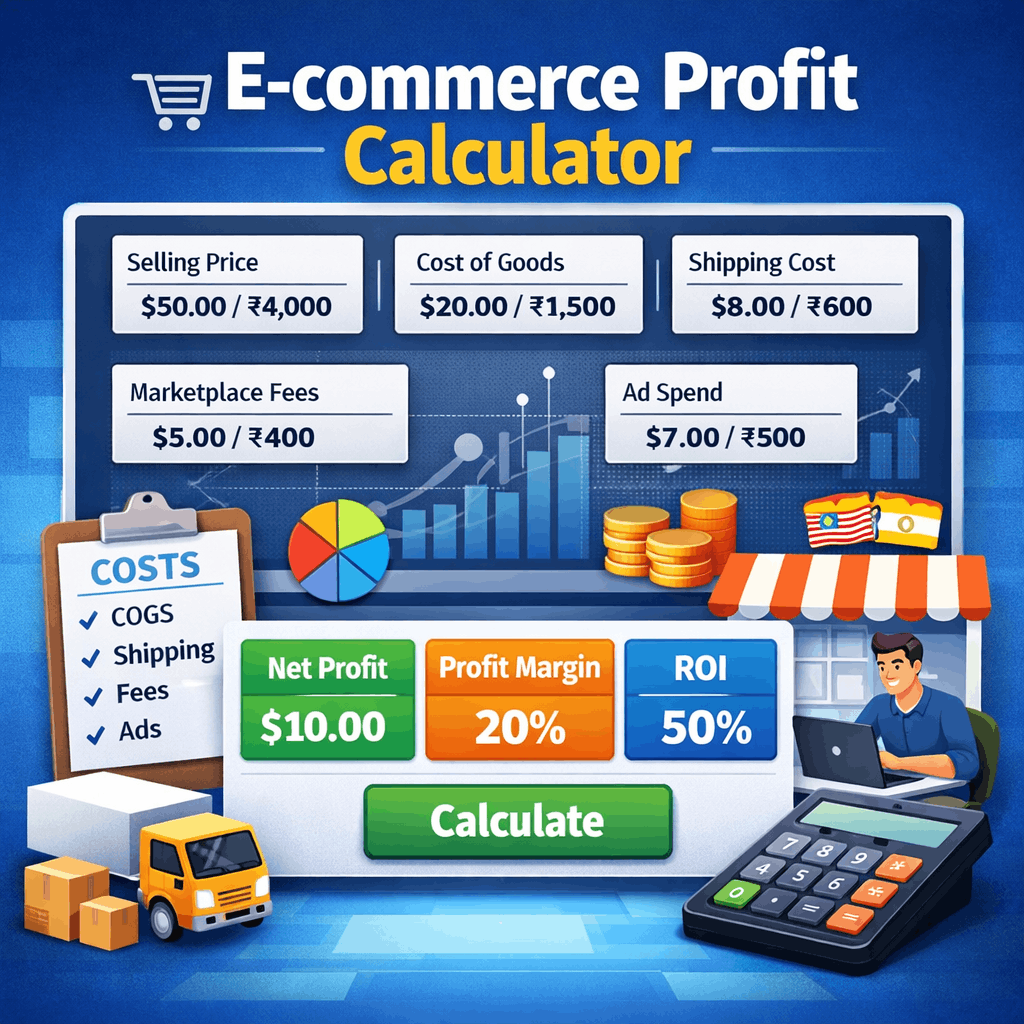
Ready to see your real numbers? Use our E-commerce Profit Calculator to instantly analyze your margins and find hidden growth opportunities in your store.
Frequently Asked Questions
1. What is a "good" profit margin for e-commerce?
While it varies by industry, a healthy net profit margin for most e-commerce businesses is between 10% and 20%. High-end luxury goods may have much higher margins, while electronics often operate on much thinner ones.
2. Does the E-commerce Profit Calculator include taxes?
Most basic calculators provide “pre-tax” profit. However, it is essential to factor in your local sales tax (like GST in India or sales tax in various US states) to get a truly accurate picture of your earnings.
How often should I check my profit margins?
You should review your E-commerce Profit Calculator results at least once a month. Costs like shipping rates and ad spend fluctuate frequently, so staying on top of your numbers prevents surprises.
4. Why is my net profit so much lower than my gross profit?
This is usually due to high “variable costs” like shipping, marketing, and marketplace fees. If the gap is too large, it’s a sign you need to optimize your operations or increase your prices.
5. Can I use this calculator for both USD and INR?
Yes! While the currency symbols change, the math remains the same. Just ensure you are consistent with your units—if your costs are in ₹, your selling price must also be in ₹.
6. What is the most important metric to track for profitability?
While all metrics matter, the “Contribution Margin” is often considered the most important. It tells you how much each individual sale contributes to covering your fixed costs and generating a profit.
Conclusion
Success in the world of online selling isn’t just about how many orders you ship; it’s about how much of that money stays in your pocket. An e-commerce profit calculator is an indispensable tool that provides the clarity needed to make smart, profitable decisions. By regularly monitoring your costs in both $ USA and ₹ India and adjusting your strategy based on real data, you can build a resilient business that thrives in any market. Take a moment today to run your numbers—your future self will thank you for the financial peace of mind.